

First Flounder. Then Float; How I Learned to Swim Faster and More Efficiently.
"Little by little, one travels far."

Don’t learn to swim for speed. Learn efficiency and form.
First Flounder. Then Float.
When you grow up in Miami, everyone you know knows how to swim.
You learn at summer camp. You start off in the shallows and each week you inch closer to depths, away from the surety of the ground. At some point, you learn to flounder. Eventually you even flounder by the deep end of a pool - always sure to hug a wall. Before you know it, in a moment of great achievement you won’t remember, you’re treading water. A little more time and you become familiar with the right amount of strength needed to stay afloat and all the little intricacies of staying upright.
Then, you start to move in a direction. No more floating still - you want to get somewhere. You struggle with that and then you learn it. Once you learn it you want to put it to the test. You ask a friend if they want to race you to the other side and he accepts and beats you. He’s had a little more practice…
It doesn’t matter though, because you learned a new skill, albeit one you take for granted as you age, even though many people have never stepped foot in a pool.
As you get older, you stop swimming the way you did as a kid. You don’t improve your technique and you never race your friends. Your swimming skills remain stagnant like many skills when you become an adult. That’s ok, for every skill you stopped working on, another, more adult one has taken its place, but eventually, you remember a skill from your childhood and something pokes at you to do it again.
Total Immersion
In 2022, I was feeling bored with my regular gym visits and short runs. As someone who likes discovering new hobbies, I picked up swimming again. I liked the idea of learning to swim for efficiency’s sake not just for going fast, so I picked up a book called Total Immersion by Terry Laughlin. I first learned of Terry on an episode of The Tim Ferris Show, which I credit for getting me back into swimming in the first place, and thus, having a massive influence on the next year of my life. I soaked up the first few chapters of the book. Each time, taking what I learned from it and putting it into practice. I even brought it to the pool some days, cross referencing it as I jumped into, and out of, the water.
I took notes on it religiously but a few tips really made a difference:
Increase your stroke length. The fastest swimmers use the fewest strokes. You want to reduce the amount of strokes it takes you to reach the end of the pool by making each stroke carry you as far as possible.
Press your buoy. Swimming requires you to reduce your drag coefficient. What creates more drag in a swim than your legs? To keep your legs in a hydrodynamic position, you need to press your chest into the water which will lift your legs up naturally.
Make your body longer. Always keep one arm stretched far ahead of your body and keep it there for a beat longer than might feel natural.
Your hands are measly anchors, but your hips are the engine. Rolling turns your body into a propeller. Your hands should simply be grabbing the rungs of a submerged ladder.
Swim like a yacht, not a barge. On your stomach, you’re like a barge with your broad shoulders forcing the water to move in front of you. “When you swim like a yacht, cutting water on your side, drag may be half as much as when you swim like a barge.” The longer you stay on your side per stroke, regardless of how unstable it feels, the farther and faster your body will travel.
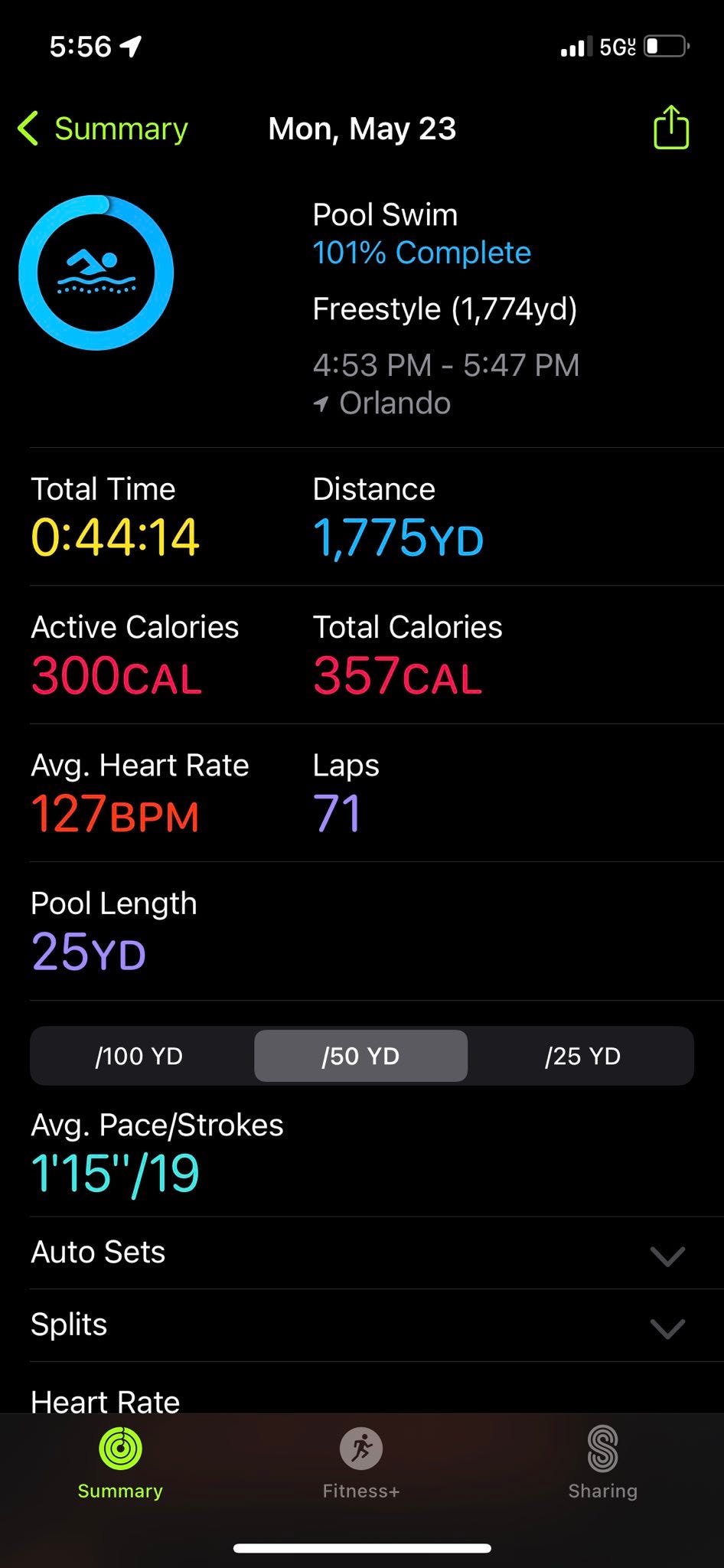
Practicing with these tips in mind had me swimming effortlessly. A couple months in and I swam my first mile without stopping. For those counting, that’s 70 laps in a pool whereas only a few months prior, I could barely breathe after 2.
Header image: The Pool—Deal, 1910, with yellow graphics of my own